what3words Ltd
Addressing & geocoding System


2018
London, UK
3wordTaxi App
Navigate to a 3 word address by just speaking it.
The project tested whether voice commands could provide a compelling and reliable way to request transportation, while demonstrating the commercial potential of integrating what3words with established ride-hailing services. Research and testing focused on voice-recognition accuracy, user trust, conversational interaction and seamless third-party API integration.
- 3m x 3mAddress resolution coveragewhat3words resolved every 3m x 3m square worldwide, enabling precise voice-friendly destination entry for taxi booking.
Context
Case Study Overview
The project tested whether voice commands could provide a compelling and reliable way to request transportation, while demonstrating the commercial potential of integrating what3words with established ride-hailing services. Research and testing focused on voice-recognition accuracy, user trust, conversational interaction and seamless third-party API integration.
The released concept received positive feedback from users, investors and partners for making taxi booking and destination entry more convenient.
The Project
3wordTaxi was a voice-enabled taxi booking concept built around what3words, which resolves every 3m x 3m square in the world to a unique three-word address. The app let users speak a destination, see the recognised phrase, confirm the destination and ETA, and then hand off the request to Uber or another ride provider. It was designed particularly for driving contexts, where users need precise navigation without taking their eyes off the road or hands off the wheel.
Challenge
Main Challenge
The central challenge was proving that a voice-enabled taxi booking experience could be robust and reliable enough for users to request a ride using only their voice. The app also needed to feel conversational rather than robotic, support a hands-off interaction, solve the ambiguity and pronunciation problems of conventional addresses, and maintain a consistent experience across multiple taxi providers and their APIs.
Problem & Opportunity
Traditional postal addresses perform poorly with voice input because similar-sounding streets and numbers are easy to confuse, unfamiliar names can be difficult to pronounce, and house or road names are not always unique. These problems are especially risky when directing a vehicle to a precise entrance or pickup point. what3words created an opportunity to replace lengthy, ambiguous addresses with memorable three-word locations that are precise and easier to speak.
Problem to Solve
The product needed to let a driver state a precise destination without typing an address, searching a map or manually correcting a dropped pin. It also had to make recognition errors visible and recoverable, ensuring that a misheard three-word address would not immediately result in an incorrect taxi booking.
Objectives
The objective was to test and demonstrate an end-to-end voice taxi journey: invoke the experience, speak a what3words destination, receive clear visual, audible and haptic feedback, confirm the recognised destination and ETA, and complete the booking through an integrated ride-hailing provider.
Main Goal
The single headline goal was to prove that users could request a taxi and navigate to a precise three-word address through a reliable, hands-free voice interaction.
Approach
Project Approach
The project followed a general UX and Product Design workflow from scope and requirements through research and analysis, concept and UX design, production design, development, sign-off and iteration. The team used continuous-improvement loops to feed findings back into the design. The approach was informed by the growing adoption of Amazon Alexa, smartphone voice queries and other voice-controlled products, while explicitly addressing early voice technology concerns around accuracy and trust.
User Testing & Research
Research examined how to make the voice interface feel like everyday conversation, including the cultural expectations and implied meanings that sit beyond literal words. Early exploration tested voice-wave visual designs, sounds and haptic feedback. Sketches covered the required input and output text, listening states, calls to action into Uber, layered waveform behaviour and multisensory progress feedback for drivers who could not continuously look at the screen.
Extensive user testing informed changes to functionality and ease of use.
Solution
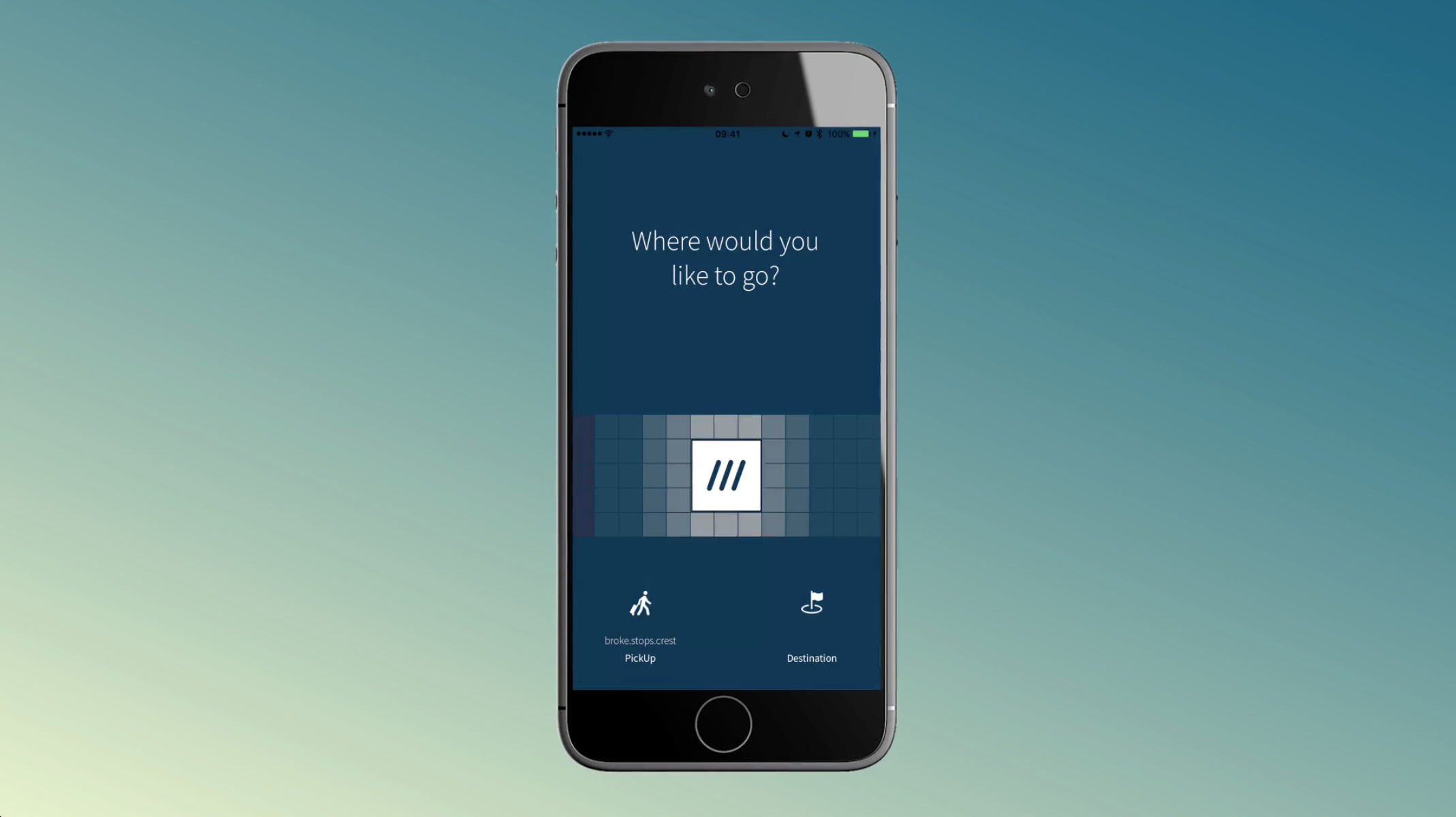
The solution combined what3words precise addressing with a conversational taxi-booking flow. A large "Where would you like to go?" prompt initiated the interaction; the spoken destination appeared as live text, was read back for confirmation, and was paired with an estimated arrival time before the request proceeded. After confirmation, the experience handed the destination into Uber's map and ride-selection flow, while the what3words system could also be integrated into automotive infotainment systems.
Decisions
UX Architecture
The V1.0 task model mapped a voice-plus-hands Uber booking journey from Siri-style invocation into a loading state, destination prompt, spoken three-word address capture, confirmation branching and request processing. It documented which feedback channel applied at each stage, including voice and sound, sound only, waveform and text, or haptic feedback.
The wider Visual Conversation flow separated pickup and destination, retained the location summary, and defined the handoff into the standard Uber request screen.
UX Design Details
The voice-wave concept tested eight tiled animation studies surrounding the fixed what3words mark. Brightness and contrast changes in the grid communicated whether the system was listening or speaking without depending on a conventional microphone icon or explanatory copy. The final interaction used a large voice prompt, live recognised text, a distinct processing state and a persistent pickup/destination summary to keep the experience calm and glanceable in an automotive context.
Results
Research Outcomes
The research established that spoken destinations should be transcribed and read back for explicit validation before a booking became consequential. A "no" response needed to loop back into correction rather than ending the journey. The flow also introduced provider comparison, for example stating that an Uber could arrive in three minutes while a Lyft could arrive in five, before asking which provider to book.
Learnings & Results
The Voice Taxi app received positive user feedback for offering a unique and convenient way to request a taxi without typing or opening a separate app. Its reception among potential investors and partners supported the viability of voice-enabled transportation and IoT products. The work contributed to what3words integrations in Mercedes, Land Rover and TomTom products, as well as compatibility with Amazon Alexa and Google Home, demonstrating the value of precise voice-friendly addressing.
Reflection
Takeaways
Voice interfaces need to make recognition visible and consequential actions reversible. In this project, precise three-word addressing solved the ambiguity of conventional spoken addresses, while read-back confirmation, correction paths and multisensory feedback built trust for a hands-free interaction.
Future Vision
A later concept extended the confirmation experience beyond the car to a smartwatch. Shown over an aerial view of Tower Bridge, it combined the question "Would you like to confirm the order?" with the car ETA, what3words mark and pickup address, suggesting a future multimodal system in which users could confirm a hands-free booking from an appropriate wearable touchpoint.
Prototype
An interactive prototype tested the conversational design from voice input through booking confirmation. It displayed the current pickup as a three-word address, read back a resolved destination such as "index.home.raft," stated an ETA such as four minutes, and asked "Would you like to confirm the order?" This made dispatch an explicit and reversible decision rather than an immediate consequence of speech recognition.
Tools & Skills
Applying the sense of everyday conversation to address input, rather than a conventional address search field.
Structuring the destination-confirmation exchange as an explicit ask / read-back / confirm loop with a correction path.
Combining visible transcription, animated waveform, sound and haptic cues so the interaction stays legible hands-free and eyes-free.
Mapping the full voice-to-booking journey, including confirmation branches and third-party handoff.
Building an interactive prototype to test the conversational design before integration.
Coordinating the voice layer across Uber, Amazon Alexa, Google Home, and automotive infotainment partners.
Tech Stack
Resolves any 3x3 metre square on Earth to a unique three-word address: the core addressing system 3wordTaxi is built around.
Used to request a ride and hand off the confirmed 3-word destination into Uber's own booking and ride-selection flow.
Smart-assistant compatibility giving users a hands-free way to order a ride via voice.
Smart-assistant compatibility extending the same hands-free ordering experience into the home.
what3words built into in-car navigation for Mercedes, Land Rover, and TomTom products.
UX Accessibility
Because drivers could not safely rely on continuous visual attention, the interface used visible, audible and tactile feedback together. Live transcription showed what the system had heard, while the tiled waveform indicated the listening state and sound and vibration communicated progress. A separate dark "...processing request..." state clarified when the system was working, helping users distinguish between moments when they should speak and moments when the request was being processed.
Experimentation and Rollout
The concept was validated through voice-flow wireframes, visual feedback explorations, an interactive prototype and extensive user testing before release. Confirmed bookings were handed into Uber's own map and ride-selection interface, while the broader concept was positioned for integration with other providers through their APIs. Related what3words integrations subsequently extended into automotive products and smart-assistant environments.
Disclaimers
Confidential
Kindly be advised that this portfolio has been carefully curated to comply with all applicable company policies and regulations. Any omissions of information or details are deliberate and in strict accordance with confidentiality agreements and legal obligations. Your understanding of this compliance measure is greatly appreciated.
Sensible Informations
The material presented here is for portfolio purposes and follows the Fair Dealing guidelines. No confidential or proprietary information from what3words Ltd has been disclosed.
My Own Views
This project is a representation of my work and does not necessarily reflect the views or strategies of the what3words Ltd.
Data Protection Act 2018 and the Computer Misuse Act 1990 Fair dealing Disclaimer - Sections 29 and 30 of the Copyright, Designs and Patents Act 1988.
Key facts
- Client
- what3words
- Year
- 2018
- Role
- Lead UX & Product Designer
- Industry
- Addressing & geocoding System
- Location
- London, UK
- Address resolution coverage
- 3m x 3m
What was the challenge in 3wordTaxi App?
The central challenge was proving that a voice-enabled taxi booking experience could be robust and reliable enough for users to request a ride using only their voice. The app also needed to feel conversational rather than robotic, support a hands-off interaction, solve the ambiguity and pronunciation problems of conventional addresses, and maintain a consistent experience across multiple taxi providers and their APIs.
What did I actually do on 3wordTaxi App?
The project followed a general UX and Product Design workflow from scope and requirements through research and analysis, concept and UX design, production design, development, sign-off and iteration. The team used continuous-improvement loops to feed findings back into the design. The approach was informed by the growing adoption of Amazon Alexa, smartphone voice queries and other voice-controlled products, while explicitly addressing early voice technology concerns around accuracy and trust.
What was the outcome of 3wordTaxi App?
The research established that spoken destinations should be transcribed and read back for explicit validation before a booking became consequential. A "no" response needed to loop back into correction rather than ending the journey. The flow also introduced provider comparison, for example stating that an Uber could arrive in three minutes while a Lyft could arrive in five, before asking which provider to book. Measured outcomes: Address resolution coverage: 3m x 3m.