Virgin Media (delivered by Squawka)
Football Media / Entertainment

2016
London, UK
Virgin LineUp Builder
A guided, mobile-first lineup builder that gave Virgin Media a way into the Euro 2016 conversation without tournament rights.
Virgin Media LineUp Builder was a Squawka-delivered Euro 2016 campaign tool. I designed a guided three-step lineup builder using live Opta data, teaching the mobile gesture before asking fans to create and share a team.
- 7xUser engagement rateUser engagement rate change in user engagementReported
- 12Social reachSocial reach change in user engagement
Context
Virgin Media LineUp Builder was a Squawka-delivered client project for Virgin Media, not in-house Virgin Media product work. Virgin Media was not a tournament rights holder. It was the UK aggregator offering Sky Sports and BT Sport in one subscription, under the standing football positioning All the football.
The strategic problem was how a distributor with no Euro 2016 rights could be present in the football conversation. The available move was to give fans something to make and pass on. The tool let a fan choose a team, choose a formation, place eleven players and share the result to Twitter, Facebook or as a link. It carried every Euro 2016 squad alongside teams from the top five European leagues and the Champions League, so a fan still had something to build after their own nation went out. Player data came from Opta Sports.
Squawka was the London football-media company running the build. I was Lead User Experience Designer, interface and interaction design, owning the interface and interaction design across the whole journey. The current record does not yet name the Squawka build and account leads or the Virgin Media stakeholders and their individual responsibilities.
Timeline: my interaction specification was collected on 19 May 2016. Virgin Media promotion is evidenced from 14 June to 10 July 2016, across the Euro 2016 knockout stages. The tournament ran from 10 June to 10 July 2016.
All the football was already live on Virgin Media's own account from at least 15 May 2016. The major BBH London television campaign launched in July 2017, so it is not treated here as the campaign wrapper for this 2016 work.
The problem
Most fans experience a major tournament as spectators. The output had to be worth posting on its own and fit how fans already argue about football, rather than ask them to learn a new habit.
The task was also fiddlier than it looked: formations, positions and real squads had to work on a phone. A blank pitch beside a list of several hundred players was a wall, not an invitation.
The hardest constraint was timing. UEFA required the 24 national squads to be submitted by 31 May 2016, ten days before the opening match on 10 June 2016, with injury replacements permitted afterwards. My interaction specification was collected on 19 May, before the squads had been announced and while they could still change. A static player list was not a viable design assumption.
What I designed
A guided path, not an open canvas
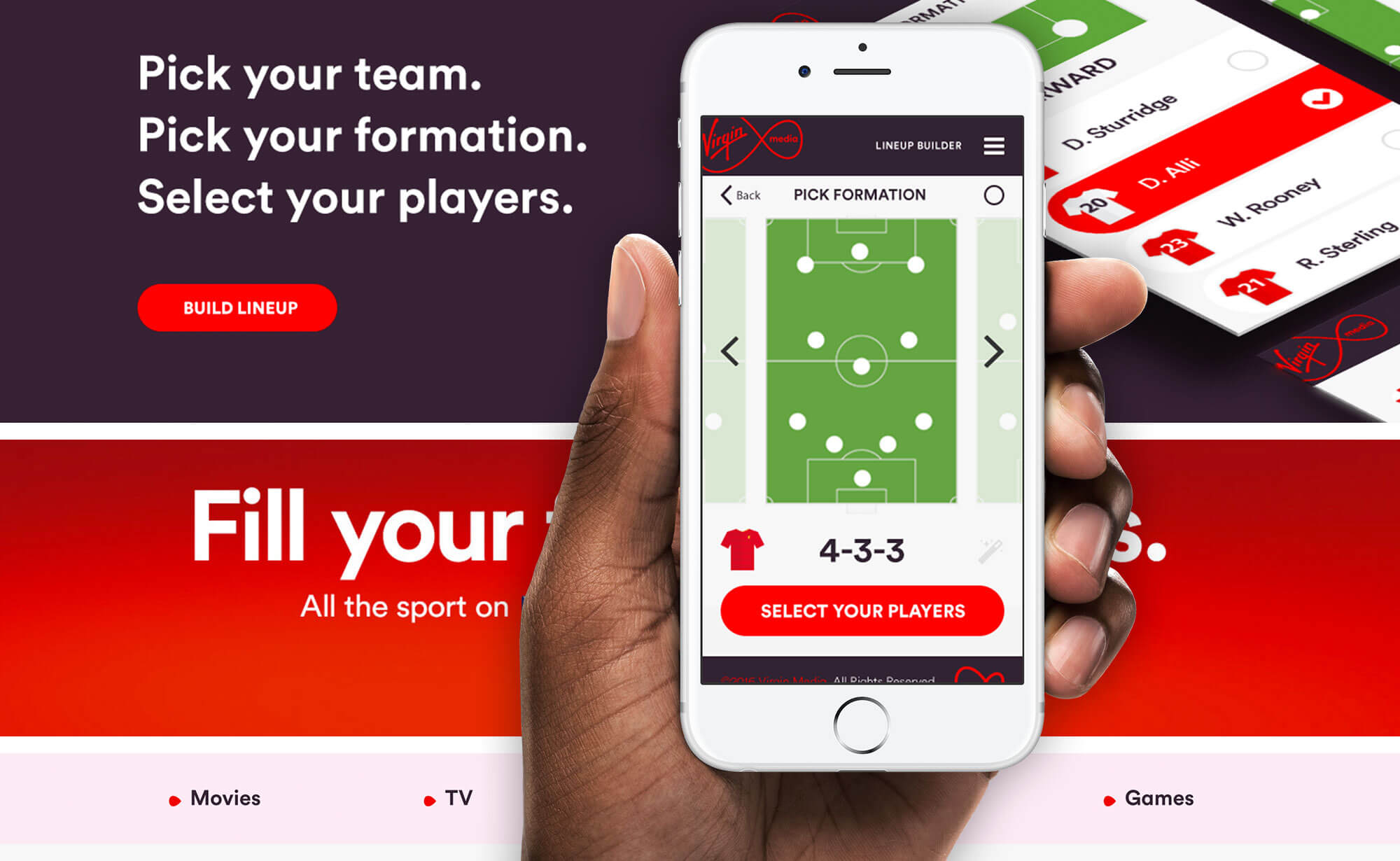
The experience had three steps: choose a team, choose a formation, then place players into the shape that formation created. Choosing the formation before the players was the load-bearing decision. It fixed the available slots, removed a class of invalid states, kept the pitch legible on a small screen and meant a fan never faced a blank pitch with 23 names beside it.
Each step carried explicit in-progress and completed states, including SELECT FORMATION / DONE, SELECT POSITION / DONE and PICK YOUR TEAM / DONE. Progress was visible rather than inferred.
Teaching the gesture before asking for it
A four-step tutorial ran before the first pick, with a tap-gesture affordance and coaching copy carried through the flow. The sequence alone was not enough. On a phone, during a tournament and with one chance at a fan's attention, the interaction had to be demonstrated before it was demanded.
One always-correct primary action
A single primary button changed by state: Pick Your Team, Select Formation, Select Position, Continue, Share Your Team and New Lineup. There was always a next correct move rather than several competing calls to action. This was the same interaction model I was using on MatchBoss at Squawka in the same weeks, a shared component-state discipline rather than a one-off pattern.
Position-typed selection, and the pitch as the answer
Player lists were typed by position. Selecting a midfielder showed midfielders, and a selected player rendered as a shirt in his slot on the pitch with the team badge and formation visible. The artefact the fan would eventually share assembled itself throughout the task, so the reward was visible before it was earned.
Supporting surfaces included a fixtures view covering the group stage, editing on a completed lineup, an information component for statistics, open and closed states for the My Team panel and competition menu, and a sticky header.
Live Opta data over a static list
The squad timetable made live data essential. It also created a design responsibility: statistics had to read at a glance on a phone while rewarding a closer look. Accurate, trusted data gave a brand without rights the credibility it needed with football fans.
Mobile first, then handed over for build
I used large touch targets, vibrant team colours and readable type. Prototypes were judged inside iPhone browser chrome rather than as flat screens. Low-fidelity wireframes became interactive prototypes tested internally, followed by beta testing with real users recruited from Squawka's football audience. The design was handed to engineering with specifications, a documented design system and a UI kit.
Decisions
Formation before players. Structure first, roles second. It cost the fan a step, but bought a pitch that was never empty, a slot that always knew what it wanted and a mobile layout that did not have to render an arbitrary arrangement.
A tutorial rather than intuitive-by-default interaction. I spent attention up front teaching four steps rather than trusting the interface to explain itself. A fan arriving from social during a tournament had no patience for a puzzle, but plenty for a game they already understood.
Live data over a static list. The squad-announcement timetable forced this decision, and the credibility benefit justified it.
Anchoring the tool to Euro 2016. A single tournament bought timeliness, cultural relevance and a reason to care that week. It also limited the product's life beyond the group stage and made it less meaningful outside Europe, even with the additional leagues and Champions League data. I would make the same trade on a three-week campaign runway, but name it as a trade at the start.
Impact
What is evidenced: Virgin Media promoted the tool repeatedly through the knockout stages under the short link virg.on/lubuilder and the #AllTheFootball hashtag. Posts on 1, 6, 7 and 10 July 2016 tied the builder to specific fixtures, including whether Wales could reach the semi-final or final and which XI could make history for the hosts.
The Virgin group account also promoted it on 14, 15, 16 and 20 June 2016, describing it as Virgin Media's Lineup Builder for building the best Euro 2016 team. Sustained client promotion across a month, escalating with the tournament, and pickup by the parent brand account are real outcomes for a campaign tool and are verifiable in the record.
Reported campaign figures: the activity was credited with 12 Twitter trends and a 7x industry engagement rate. These are reported campaign figures, not instrumented product analytics traceable to the builder. I cannot establish their producer or scope, and the record does not break them into lineups created, shares or return visits. They remain reported rather than measured.
Contemporary searches recover almost no organic user conversation about the tool. Two non-official posts from the launch window carry identical copy and the same image, which is consistent with seeded placement rather than independent fan sharing. That is weak evidence nine years later, and a share flow can work without leaving retrievable traces. The defensible claim is narrower: I can demonstrate that the client promoted the builder heavily, but I cannot demonstrate from the surviving record that fans passed it on organically.
What the work establishes:
- A brand without rights can still be present in a moment if it gives people something to make rather than something to watch.
- Accurate data from a trusted provider is what makes a football tool credible enough for fans to take seriously.
- The guided flow held through a genuinely fiddly task on a phone, in a three-week build, against squads that changed underneath it.
Reflection
What worked. Teaching before asking. The tutorial was the cheapest part of the build and the reason the rest of it functioned. Building against a live feed also turned a scheduling constraint into the feature that made the tool credible.
What I would change. The share flow asked for an email address at the moment of completion, exactly when a fan most wanted to post their lineup and least wanted a form. I placed a commercial ask on top of the emotional peak of the product. In the same weeks, MatchBoss showed me that 296 people out of 813 could build a complete team and still abandon it at the commitment gate. I did not carry that lesson across. If I built this again, capture would come after the share completed, or not at all.
What I underestimated. MatchBoss generated genuine unprompted sharing from real accounts for months; the LineUp Builder, built explicitly to be shared, generated almost none that I can find. The difference was not the share button, the design or the reach. It was stakes. People posted MatchBoss picks because money and a leaderboard position were attached to being right. A Virgin lineup was an opinion with nothing riding on it. If the brief is sharing, the design question is what the fan is risking, not how many networks the button supports.
What stays. For a tournament tool, the design problem is not the pitch, the data or the formations. It is the first ten seconds. Everything worth doing in this build happened before the fan picked their first player.
Prototype
The prototype covered the complete guided journey: choose a team, choose a formation, select players into the available positions, then share the finished lineup.
A four-step tutorial taught the tap gesture before the first selection. The connected mobile-first flow was tested internally and then in beta with football fans recruited from Squawka's audience.
The final experience used live Opta Sports data and supported sharing through Twitter, Facebook and a copied link.
UX Accessibility
Accessibility was treated as part of the mobile interaction design, not as a final visual check.
- Large touch targets for team, formation and player selection.
- High-contrast colour and readable type on small screens.
- A guided sequence that reduced the cognitive load of building a lineup.
- Interaction states that did not rely on colour alone to communicate progress or selection.
The available record does not document a formal screen-reader or keyboard audit, so I have not claimed one here.
Disclosure
This case study is shared for portfolio purposes and follows Fair Dealing guidelines. Some information has been withheld for confidentiality, and no confidential or proprietary Virgin Media or Squawka information is disclosed.
Design and interaction detail is drawn from my 2016 project files. The 12 Twitter trends and 7x engagement rate are reported campaign figures whose source and scope are not established here, so they are stated as reported rather than measured. Details of Virgin Media's football positioning, its Southampton FC sponsorship and the 2017 All the Football advertising campaign are matters of public record, as are the promotional posts referenced here.
The work shown represents my own contribution and does not necessarily reflect the views or strategies of either business. Any forward-looking ideas are my personal perspective.
Some information and details have been withheld for confidentiality. This material is presented for portfolio purposes and does not disclose confidential or proprietary information from Virgin Media or Squawka.
Key facts
- Client
- Virgin Media (delivered by Squawka)
- Year
- 2016
- Role
- Lead User Experience Designer
- Industry
- Football Media / Entertainment
- Location
- London, UK
- User engagement rate
- 7x
- Social reach
- 12
What was the challenge in Virgin LineUp Builder?
Most fans experience a major tournament as spectators. The output had to be worth posting on its own and fit how fans already argue about football, rather than ask them to learn a new habit.
What did I actually do on Virgin LineUp Builder?
The experience had three steps: choose a team, choose a formation, then place players into the shape that formation created. Choosing the formation before the players was the load-bearing decision. It fixed the available slots, removed a class of invalid states, kept the pitch legible on a small screen and meant a fan never faced a blank pitch with 23 names beside it.
What was the outcome of Virgin LineUp Builder?
What is evidenced: Virgin Media promoted the tool repeatedly through the knockout stages under the short link virg.on/lubuilder and the #AllTheFootball hashtag. Posts on 1, 6, 7 and 10 July 2016 tied the builder to specific fixtures, including whether Wales could reach the semi-final or final and which XI could make history for the hosts. Measured outcomes: User engagement rate: 7x; Social reach: 12.