what3words Ltd
Addressing & Geocoding, Postal Services & Logistics

2017
London, UK
what3words OCR Sorting & Delivery App
Sorts and routes deliveries by scanning a 3 word address, even offline.
An OCR-based mobile app designed for Mongol Post to scan what3words addresses, sort parcels into delivery-area bins, and calculate optimized delivery routes. The product addressed Mongolia's lack of consistent street addressing and vast, sparsely populated geography, improving sorting accuracy, delivery success, and operational efficiency.
- 18%Successful first-time delivery rateIncreased the share of deliveries completed successfully on the first attempt.
- 15%Sorting accuracy improvementImproved parcel sorting accuracy in the delivered OCR app and partnership results.
- nearly 3 minutesDelivery time reductionReduced the time required to process each delivery.
Context
Case Study Overview
Mongolia's semi-nomadic population of roughly three million people is spread across an area nearly the size of the European Union, without a consistent street-addressing system. Customers often traveled kilometres to collect mail, while deliveries depended on landmarks and phone calls, causing high costs and failed deliveries. Through the Mongol Post and what3words partnership, customers entered a three-word address at checkout, postal staff scanned it for sorting, and drivers used the resolved location and optimized route to deliver to precise 3x3 metre locations.
The Project
The project was an Optical Character Recognition mobile app for Mongol Post that read three-word addresses from parcel and envelope labels. Scanned items were assigned to delivery-area bins, and those bins were used to organize parcels and calculate efficient delivery routes, including routes accessible offline. The product supported both sorting-office workers and delivery drivers.
Challenge
Main Challenge
Mongol Post needed to improve sorting accuracy and delivery success across Mongolia's vast, sparsely populated landscape. Manual or imprecise addressing created long journeys for customers, expensive delivery operations, and failed first attempts. The system also had to work quickly for postal staff and support drivers who might be operating offline.
Problem & Opportunity
In many parts of Mongolia, residents had to collect mail from distant post-office boxes; one cited customer had never received a letter at home in her 80 years. The opportunity was to make home delivery practical by first creating a precise address, then converting the three-word address on a physical label into a fast, low-error sorting and routing decision.
Problem to Solve
The specific problem was how to capture and validate a three-word address from a parcel or envelope, assign it to the correct delivery bin, and carry that information through to route planning without requiring slow manual entry. A failed OCR read needed to be visible rather than silently advancing the worker to the next item.
Objectives
The work set out to provide a lower-cost, low-interaction way to implement precise address technology within existing postal workflows. The app needed to reduce human error, accelerate sorting, organize items by delivery area, and give drivers an efficient route to the destination.
Main Goal
The headline goal was to make reliable, successful delivery possible for citizens across Mongolia by turning a what3words address into an accurate sort-and-route workflow.
Approach
Project Approach
The approach began with a product audit and research into customer expectations, delivery pain points, and lower-cost ways to implement addressing technology. The workflow was separated into two modes, sorting and delivery, then mapped as a Log → Sort → Route pipeline. A detailed task model covered Acquire, Log, Validate, Sort, Store temporary data, and Acquire another item, with explicit failure branches and annotated UI states before the scanning and bin-management screens were prototyped.
User Testing & Research
Research examined daily e-commerce delivery tasks, customer expectations, operational pain points, and ways to minimize interactions during postal work. Prototype testing covered the scan-to-confirmation flow and bin-card popup, while a field test used a realistic handwritten envelope rather than only clean digital labels. The research emphasized supporting human workflows while reducing the cost and time required to implement precise addresses.
Solution
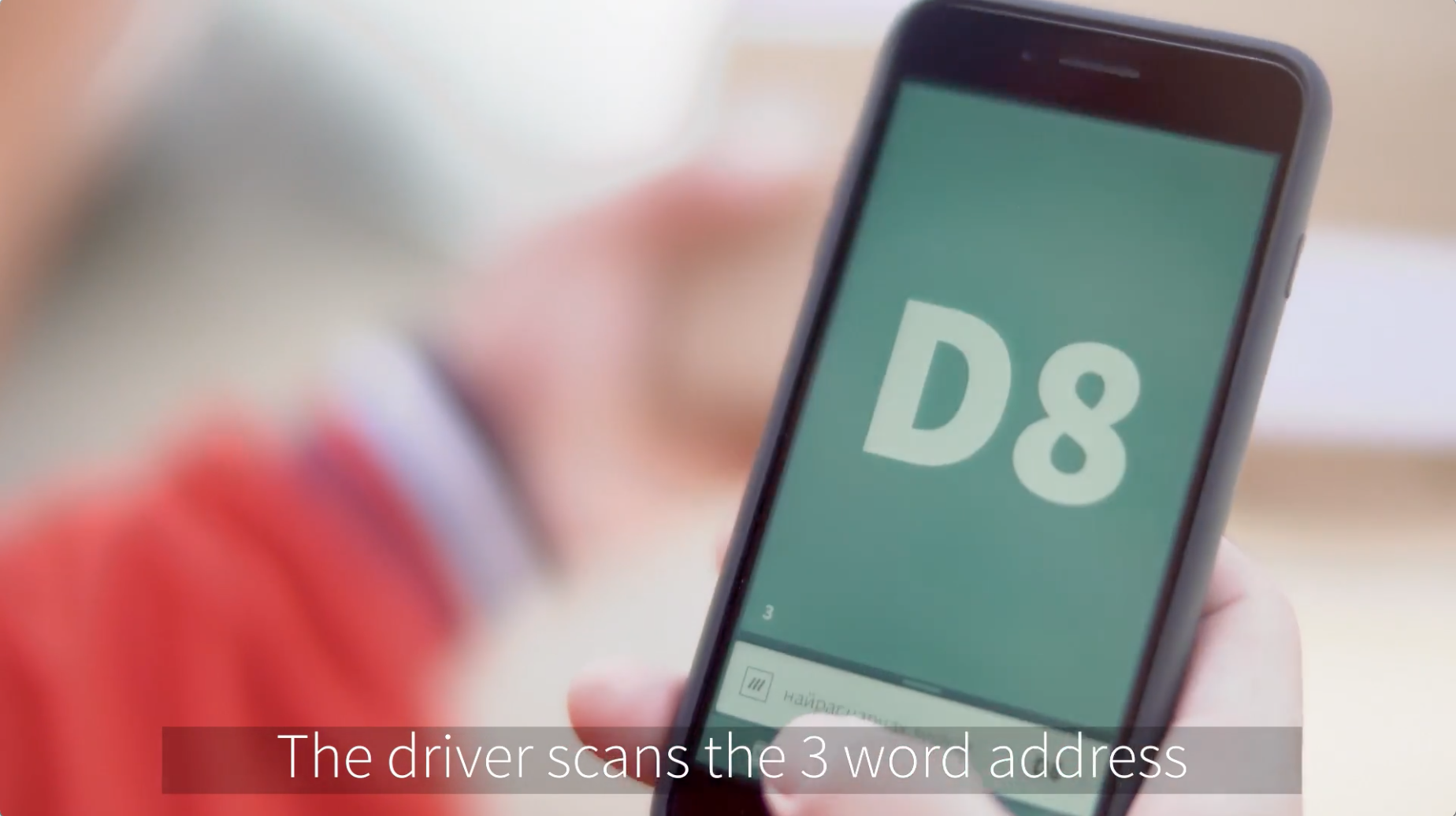
The solution integrated what3words into Mongol Post's operations through an OCR scanning app. Workers scanned a label, confirmed the recognized three-word address, and received a bin assignment; the bin grouped deliveries by area and supported route optimization. Drivers could scan the address to access the route and see a clear, glanceable bin or delivery instruction.
Decisions
UX Architecture
The information architecture separated the product into two core work modes: sorting-office staff identify and log an item, validate its address, and sort it into a bin; drivers identify and log the item, obtain the best route for the bin, and confirm delivery. The task model structured the flow around acquisition, validation, sorting, temporary storage, and repeat scanning, with saved-items lists and bin-level parcel organization supporting the operational pipeline.
UX Design Details
The scanning screen used white corner guides to define the label area and froze the captured image when an address was detected. Successful reads displayed the recognized address and bin name with a confirmation action, followed by a brief full-screen bin-letter state; unreadable text generated specific errors such as "Text too small" or "Scan failed" and offered a rescan.
A latest-history panel showed the five most recent scans by default, while bin views provided searchable, scrollable three-word-address cards, status controls, and a map of parcels across areas such as Notting Hill, Westbourne Green, Bayswater, and Palace Green.
Results
Research Outcomes
The research established that Mongolia's delivery problem was fundamentally an addressing problem as well as a routing problem. It showed that OCR could connect imperfect physical labels to a bin and route while preserving a fast human workflow, provided that failed reads, validation, confirmation, and recovery states were explicit.
Learnings & Results
The delivered OCR app reduced the time required to address a delivery to one week, compared with several weeks previously. Published partnership figures report 15% higher sorting accuracy, nearly three minutes saved per delivery, and an 18% increase in successful first-time deliveries; the case study's internal results also describe a 12-point improvement in sorting accuracy.
The product improved delivery efficiency, reduced costs, organized bin tracking, and helped Mongol Post reach more customers and build trust.
Reflection
Takeaways
A precise addressing system creates value only when it is integrated into the physical workflow that follows it. The strongest result came from connecting capture, validation, sorting, bin organization, and route planning into one low-interaction flow, with clear recovery states for imperfect OCR input.
Future Vision
The approach could be extended to other countries facing unreliable or inconsistent street addressing. The article identifies potential for broader use of what3words-based OCR, sorting, and route optimization across postal and e-commerce delivery operations where precise locations, faster last-mile work, and higher first-attempt success are needed.
Prototype
The interactive prototype focused on the two most important sorting-floor moments: scanning a label through to a confirmed OCR result, and opening a bin-card popup that presented the assigned bin instruction at a glance. A field-test prototype was also tested against a real handwritten envelope, resolving the address to "///standards.billiard.turntable" and assigning sorting bin "B3".
Applied Skills
Audited the existing scan-and-sort workflow to find where OCR could remove manual steps.
Investigated e-commerce delivery pain points and customer expectations to ground the sorting and delivery workflow.
Mapped the Acquire → Log → Validate → Sort → Store → Acquire-another task model and the Sorting vs Delivery work modes.
Wireframed the scanning screen, bin management, and scan-history states.
Built an interactive prototype of the scan-to-confirmation flow and the bin-card popup.
Technology & Approach
Reads a printed 3 word address directly off a parcel or envelope label, removing manual data entry.
Resolves the scanned 3-word address to a precise location and a delivery bin.
Uses the assigned bin to calculate an optimized delivery route, accessible even without a live connection.
Lets a worker add or confirm a 3 word address by typing or dictating it, with a suggested-match confirmation step before it's accepted.
Experimentation & Rollout
The concept was exercised through interactive prototypes of scanning, confirmation, and bin-card behavior, then tested with realistic handwritten mail. The broader product was piloted in urban Mongolia as part of Mongol Post's rollout of what3words, which had become integral to its operations in 2016. The workflow was designed for operational use, including offline route access and a driver-facing scan that reduced the result to a single high-contrast bin instruction.
Disclaimers
Confidential
Kindly be advised that this portfolio has been carefully curated to comply with all applicable company policies and regulations. Any omissions of information or details are deliberate and in strict accordance with confidentiality agreements and legal obligations. Your understanding of this compliance measure is greatly appreciated.
Sensible Informations
The material presented here is for portfolio purposes and follows the Fair Dealing guidelines. No confidential or proprietary information from what3words Ltd has been disclosed.
My Own Views
This project is a representation of my work and does not necessarily reflect the views or strategies of the what3words Ltd.
Data Protection Act 2018 and the Computer Misuse Act 1990 Fair dealing Disclaimer - Sections 29 and 30 of the Copyright, Designs and Patents Act 1988.
Key facts
- Client
- what3words
- Year
- 2017
- Role
- Lead UX & Product Designer
- Industry
- Addressing & Geocoding, Postal Services & Logistics
- Location
- London, UK
- Successful first-time delivery rate
- 18%
- Sorting accuracy improvement
- 15%
- Delivery time reduction
- nearly 3 minutes
What was the challenge in what3words OCR Sorting & Delivery App?
Mongol Post needed to improve sorting accuracy and delivery success across Mongolia's vast, sparsely populated landscape. Manual or imprecise addressing created long journeys for customers, expensive delivery operations, and failed first attempts. The system also had to work quickly for postal staff and support drivers who might be operating offline.
What did I actually do on what3words OCR Sorting & Delivery App?
The approach began with a product audit and research into customer expectations, delivery pain points, and lower-cost ways to implement addressing technology. The workflow was separated into two modes, sorting and delivery, then mapped as a Log → Sort → Route pipeline. A detailed task model covered Acquire, Log, Validate, Sort, Store temporary data, and Acquire another item, with explicit failure branches and annotated UI states before the scanning and bin-management screens were prototyped.
What was the outcome of what3words OCR Sorting & Delivery App?
The research established that Mongolia's delivery problem was fundamentally an addressing problem as well as a routing problem. It showed that OCR could connect imperfect physical labels to a bin and route while preserving a fast human workflow, provided that failed reads, validation, confirmation, and recovery states were explicit. Measured outcomes: Successful first-time delivery rate: 18%; Sorting accuracy improvement: 15%; Delivery time reduction: nearly 3 minutes.